
Technology · Investment
The complete map of the AI boom and its key players
Contents
- 1. Semiconductor Ecosystem: An Interconnected Chain
- Main uses of advanced chips:
- 2. Insights from Elon Musk: Memory as the Biggest Challenge and Gas Turbine Shortages
- 3. Summary of the Jensen Huang Interview: Focus on Compute and Context in AI
- 4. Connections between Musk and Huang: Common Bottlenecks in AI and Energy
- 5. Valuation Ratios
- Analysis of Most Attractive Ratios and Growth Opportunities:
Miguel Braun · Feb 9 · 6 min read
Dear all,
This report summarizes the key ecosystem in the semiconductor industry, incorporating recent insights from interviews with leaders such as Elon Musk (CEO of Tesla, SpaceX and xAI) and Jensen Huang (CEO of NVIDIA). I will focus on the challenges in memory, chips and power generation, connecting these points to highlight investment opportunities. We will also explain who is who and what each of the companies involved does.
1. Semiconductor Ecosystem: An Interconnected Chain
The production of advanced chips for AI and high-performance computing depends on a highly specialized global ecosystem:
ASML: Leader in EUV (extreme ultraviolet) lithography machines, essential to manufacture chips at nanometric scales (e.g., 3nm or less). ASML dominates the market with roughly 90–94% of the global lithography equipment market (including ~100% in EUV for advanced nodes), meaning more than 90% of the world's advanced chips (especially leading-edge) are manufactured using its machines. Without its machines, cutting-edge semiconductor production would be impossible.
TSMC: The main foundry (contract manufacturer) that uses ASML's machines to produce logic chips. As a "pure-play foundry", TSMC manufactures for clients such as NVIDIA, Apple and AMD, without competing in design. Its location in Taiwan adds geopolitical risks, but its efficiency makes it indispensable, capturing roughly 70–72% of the global (pure-play) foundry market, equivalent to a dominant share of the advanced chips produced worldwide.
NVIDIA: Specialized in chip design, particularly GPUs for AI, gaming and data centers. NVIDIA does not manufacture; it subcontracts to TSMC. Its software (e.g., CUDA) and architectures like Hopper/Blackwell drive the AI boom, with record revenues fueled by hyperscaler demand (e.g., AWS, Microsoft), who buy many of the chips they use from NVDA.
Memory manufacturers (Micron, SK Hynix, Samsung): These supply DRAM and NAND memory, crucial for storage and fast processing in chips. In AI, high-bandwidth memory (HBM) stands out, allowing large volumes of data to be handled. Samsung also operates a limited foundry, but the trio dominates ~90% of the memory market, with recurring shortages affecting prices and supply.
Hyperscalers (AWS/Amazon, Google Cloud/Alphabet, Microsoft Azure, Meta): Operators of the massive data centers that consume most of the GPUs and memory for AI training and inference. They are the main end customers of NVIDIA, TSMC and memory manufacturers, and they drive much of the current explosive demand.
AWS (part of Amazon) and Google Cloud (part of Alphabet) are the main hyperscalers consuming large volumes of AI infrastructure, contributing significantly to the sector's growth. Examples of clients: AWS includes Netflix (historical #1 client), OpenAI, Anthropic, Salesforce, Visa, BlackRock and big names like Apple and Meta.
Google Cloud stands out with Meta (deal >$10B), Spotify, Target, Samsung, L'Oréal, Uber and many AI labs/unicorns. Recent growth: In Q4 2025, AWS grew 24% YoY (revenues ~$35.6B, annual run rate ~$142B). Google Cloud showed explosive 48% YoY growth (revenues ~$17.7B, run rate >$70B), driven by AI infrastructure and enterprise solutions demand.
Main uses of advanced chips:
- - AI model training and inference (LLMs, computer vision, autonomous agents).
- - Data centers and cloud computing (AWS, Google Cloud, Azure, Meta).
- - Supercomputing and scientific simulations.
- - Gaming and high-performance graphics.
- - Autonomous vehicles, robotics and edge AI.
Today, more than 70–80% of demand growth comes from generative AI applications and data centers, explaining the extreme pressure on the entire supply chain.
This ecosystem faces growing pressure from AI expansion, where demand for compute and memory exceeds supply, creating price volatility and opportunities for investors in companies exposed to these chains.
2. Insights from Elon Musk: Memory as the Biggest Challenge and Gas Turbine Shortages
In a recent interview with Dwarkesh Patel (podcaster) and John Collison (co-founder of Stripe), Elon Musk emphasized critical bottlenecks in AI scalability. Musk argued that memory is harder to scale than logic chips, stating that "the memory shortage worries me more than the logic chip shortage" over the next 3–4 years.
This is due to the complexity of manufacturing high-density memory (e.g., HBM for AI GPUs), which requires precise processes and advanced materials. Unlike logic chips, where TSMC and peers can ramp up production, memory faces limits on fab capacity and raw materials, exacerbating prices and delays. Musk predicts this will constrain the deployment of massive AI clusters.
Additionally, Musk highlighted the shortage of gas turbines for data centers, driven by power demand for AI training (e.g., a 330,000 NVIDIA GPU cluster requires ~1 GW of power). Key manufacturers —GE Vernova, Siemens Energy and Mitsubishi Power— control >75% of the global market, but are backlogged to 2030. The limiting factor are the "vanes and blades" in turbines, a specialized casting process handled by only three companies worldwide (e.g., Precision Castparts, CPP, Doncasters). This creates 12–18 month queues, forcing innovations like space-based data centers (Musk predicts space will be the cheapest place for AI in <36 months, using unlimited solar power via Starship).
3. Summary of the Jensen Huang Interview: Focus on Compute and Context in AI
In his interview (available on YouTube), Huang describes AI at an "inflection point", moving from curiosity to practical tools that reason, investigate and use tools (e.g., Excel). He highlights the emerging profitability: companies like Anthropic and OpenAI generate substantial revenues, with potential to quadruple if compute is doubled. Huang emphasizes "context" in AI —"contextually aware" software that considers user, history and data in real time, generating unique outputs each time. This implies a growing role for memory, since handling large contexts (e.g., long histories, documents) requires high-performance memory to avoid processing bottlenecks.
Huang sees GPU demand as "sky high", with hyperscalers like AWS and Azure constrained by compute, not profitability. He predicts a 7–8 year infrastructure build-out, followed by refreshes, comparing it to past investments like AWS (now $140B in revenues). He doesn't mention memory explicitly as a bottleneck, but the emphasis on scale and context suggests it is implicit, aligned with AI's evolution toward "agentic" models.
4. Connections between Musk and Huang: Common Bottlenecks in AI and Energy
Both CEOs agree that AI faces physical limits: Huang on compute and context (which demands more memory and GPUs), Musk on memory and energy. The "memory context" Huang refers to in his interview —handling massive data for reasoning— exacerbates the memory shortage that Musk prioritizes over logic chips. Also, data center demand (driven by NVIDIA's tech) collides with the gas turbine shortage, as Musk details. This creates a cycle: more AI requires more chips/memory (TSMC, Micron et al.), which need more energy (GE Vernova et al.), potentially leading to innovations like orbital computing.
5. Valuation Ratios
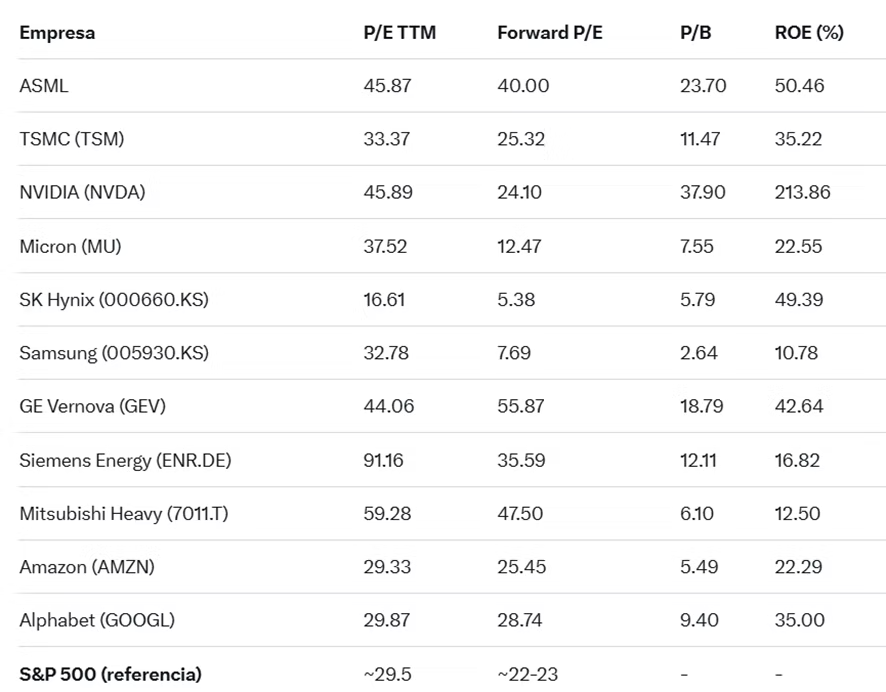
Analysis of Most Attractive Ratios and Growth Opportunities:
Based on standard criteria (low P/E and P/B indicate attractive value, high ROE reflects efficiency and growth potential), SK Hynix shows the most attractive ratios. Its forward P/E of 5.38 is exceptionally low, suggesting the market is underestimating its future growth, while its 49.39% ROE indicates strong profitability on equity. This aligns with the report: Musk emphasizes memory shortage as the major bottleneck in AI, benefiting leaders like SK Hynix in HBM. Samsung, the other major memory and chip producer, also has extremely attractive valuation ratios.
What's the problem? Neither of these two stocks trades in the United States nor has a cedear, limiting our investment options since the companies trade in South Korea. The same happens with Mitsubishi, which trades in Japan and also has no ADR.
Amazon and Alphabet show reasonable valuations (P/E TTM ~29–30, forward ~25–29), with solid ROE and direct exposure to AI data centers, positioning them well in the growth cycle. TSMC and ASML also stand out for their near-monopoly position in the production of chip-making machines and chips worldwide.
The S&P 500 trades at P/E TTM ~29.5 and forward ~22–23, so many of these companies (especially memory) appear with more attractive valuations relative to the index.
If I had to pick by valuation ratios and fundamentals:
• Micron – as the only North American memory producer and at attractive prices.
• Taiwan Semiconductors – for its dominant position in chip manufacturing and attractive ratios given that.
• NVDA – because they design the best AI chips. As the CEO says: "Demand for GPUs is skyrocketing" and "We are practically everywhere".
• Google / Amazon as you prefer – as owners of the data centers and servers where many businesses run.
That's all for today, I hope the report has been useful!

Financial Advisor · Author · Columnist