
Argentina · Strategy
What do we do with the pesos?
Miguel Braun · Sep 11, 2024 · 5 min read
Dear all, good morning.
I'm writing this time to answer a question several of you have been asking me in recent days: What do we do with the pesos?
As you well know, in recent days the dollar has been falling. This isn't entirely good for the price of CEDEARs and local stocks with ADRs abroad, since as they are dollarized assets, every time the dollar falls, the price of these assets in pesos falls too.
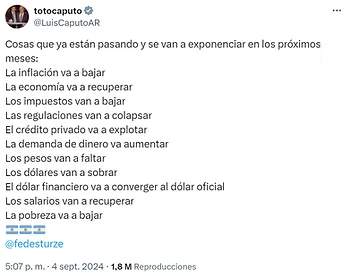
According to Economy Minister Luis Caputo, the financial dollars will end up converging with the official USD without the need for a devaluation:
https://x.com/LuisCaputoAR/status/1831423786610258101 This would imply the dollar can keep falling. The argument is: if the amount of pesos stays fixed because there is no monetary issuance, but the amount of dollars in the economy increases due to the RIGI, the tax amnesty and all the other investments that should come into the country if we do things right... the peso would become scarcer than it is now versus the dollar and could keep falling. To this would be added an increase in peso demand from the reactivation of the economy.
Our country's history makes it very hard for us to save in pesos. Most of us save in USD or prefer to invest in dollarized assets, and that is perfectly fine. If what Toto Caputo says eventually happens, this would be a paradigm shift for Argentina.
How to protect ourselves in this scenario?
For companies:
We can build a portfolio that is 50% in pesos and 50% in dollarized assets, so as to preserve capital in any scenario.
Peso portfolio:
10% money market fund with immediate liquidity, 20% CER bonds
20% fixed rate in pesos via Treasury bills. Dollar-linked instruments got very expensive and I think at these prices they are no longer attractive.
Portfolio in peso-denominated but dollarized assets (that track the CCL):
20% AL30D, 10% SPY
10% Galicia, 10% Vista/Pampa
For individuals:
It is very hard for many people to sell their USD and start earning a rate in pesos, even if they believe the dollar can keep falling. For those who dare to do this, the first portfolio recommended for companies will let them earn a bit more rate than an ordinary premium FIMA fund.
The truth is we don't know if what Toto Caputo says will happen and how long it might take. I wouldn't feel comfortable selling all my USD and just earning a rate in pesos. I like to invest in productive assets, that is: top-tier companies, and this way avoid guessing what will happen with the peso and the dollar.
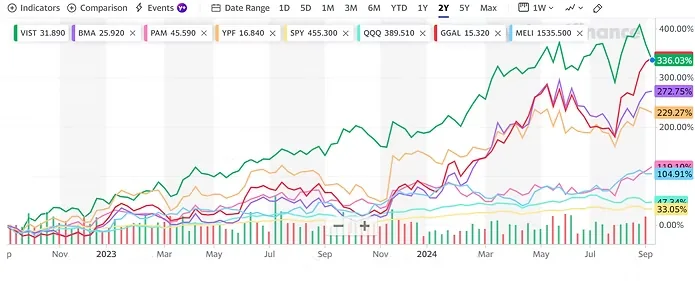
The performance of Argentine stocks over the last two years has been impressive. The ones that rose the most were Vista and Banco Galicia, with an impressive 335% rise in USD. Then come Banco Macro, YPF, Pampa and Mercado Libre respectively. Far behind all these companies comes the return of the S&P 500 (SPY) and the U.S. tech stocks (QQQ).
This is what I mean when I say I prefer to invest in productive assets and thus avoid guessing what will happen with the peso and the dollar.
Some of these stocks rose a lot in recent days and are a bit far from their moving averages, but when they dip a little, I think it is a good time to get back in strongly. Argentina today is the best investment in the world, because we are still cheap since valuations were rock-bottom from the pandemic and Alberto Fernández's government. Also:
- We still haven't lifted the controls
- The economy hasn't reactivated yet
- Taxes have barely been cut
- Milei hasn't even completed a year in office and is just starting to implement his reforms
- The surplus and zero emission are already consolidated
- The RIGI and the tax amnesty have been approved and more investments should start arriving
- Country risk is still very high and stocks far from their all-time highs
- A global drop in interest rates is coming
- Argentina is still rated as a "stand-alone" market
Banks are the big winners of this scenario Toto Caputo proposes in which the financial dollars converge to the official one (i.e., they close the spread from top to bottom). The reason is that banks are full of pesos, and if the peso appreciates against the dollar, it means all the pesos the banks hold will mean more dollars... which should increase the banks' valuation in dollars and therefore push up their stocks.
This on top of the fact that banks currently have their assets earning a rate in pesos, so they benefit doubly if the dollar also falls. If we add the amnesty, the return of credit and the reactivation of the economy... I think banks still have room to keep growing.
The other most attractive sector in Argentina is Oil & Gas, without a doubt. We are at an all-time record of oil and gas production, mainly from Vaca Muerta. New infrastructure works are being built that will allow increasing the evacuation and transport capacity of all the production: the new pipeline, the reversal of the northern gas pipeline that will allow exporting gas to Bolivia and Brazil, the reactivation of the pipeline to Chile and the construction of a deep-water port in Neuquén to export Vaca Muerta oil on large ships. In this context, Vista, YPF and Pampa appear as the big winners. So a 100% long-Argentina portfolio could be:
20% Banco Galicia, 20% Banco Macro, 20% Vista, 20% YPF
20% Pampa Energía. The freeing of the FX market — which hasn't happened yet — would also be very positive for all these stocks. In conclusion:
Argentina seems to be a great investment against a world whose valuations are much more expensive than ours and that faces risks of entering a recession or an economic slowdown. While we won't be discovering anything new by buying U.S. stocks, more and more analysts at international banks are daring to recommend Argentine stocks and put "price targets" much higher than they are worth now. We come from years of currency devaluations, defaults and rock-bottom valuations, but maybe that can start to change. As we saw, if that happens, the returns of Argentine stocks will be spectacular and will far exceed the returns of the U.S. market.
Tomorrow the European Central Bank is expected to cut interest rates for the second time this year, and next week the U.S. Fed is expected to start its rate-cutting process too. This is a tailwind for Milei's government and for the Argentine peso, which would be less prone to devaluing.
For those who are corporate clients, it is not bad at all to position 50% in assets to earn a rate in pesos and the other 50% in dollarized assets that have upside if Argentina does well, like the assets I mentioned earlier: AL30, Galicia, Vista and Pampa. If you don't want to buy individual stocks you can always buy the SPY index (S&P 500) of the U.S.
For individuals, it is the time to invest in Argentine stocks, which will also have a lot of upside if the peso strengthens. This way you also avoid guessing what will happen with the dollar price, which can keep falling.
I choose to believe the lean years are over, and finally, after a very long wait, the fat years arrive for Argentina. We have all the potential to grow, in human capital and in natural resources.
If you have pesos, invest them in Argentina!
That's all for today, I hope you liked it.
I send you my regards, have a good day.
Miguel

Financial Advisor · Author · Columnist