
Argentina · Monetary Policy
Why does the BCRA deserve to be shut down forever?
Contents
Miguel Braun · Oct 6, 2022 · 19 min read
How could an orderly transition leading to its closure be carried out?
5 concrete measures to cut public spending. Let's get started...
In the United States, the Fed's mission is to try to achieve full employment and price stability. For this, they are in charge of regulating interest rates and the supply of USD in the economy to reach their proposed objectives.
In Argentina, the BCRA's purpose is to "Promote, to the extent of its powers and within the framework of the policies established by the national government, monetary stability, financial stability, employment and economic development with social equity".
In addition, article 4 of its charter establishes that: "In the exercise of its functions and powers, the bank shall not be subject to orders, indications or instructions from the National Executive Power, nor may it assume obligations of any nature that imply conditioning, restricting or delegating them without the express authorization of the Honorable Congress of the Nation."
We can then observe that according to its charter, the BCRA should be an independent entity whose objective is to promote:
- Monetary stability
- Financial stability
- Employment
- Economic development with social equity. Let's see if the BCRA has been able to meet the objectives set at the time of its creation:
Monetary stability:
As a result of the 1935 monetary and banking reform, the Central Bank of the Argentine Republic (BCRA) was born as a mixed entity with state and private participation, which had among its functions the exclusivity in the issuance of banknotes and coins and the regulation of the amount of credit and money, as well as the accumulation of international reserves, the control of the banking system and acting as the State's financial agent. The monetary authority is thus endowed with instruments that allow it to play the role of "lender of last resort" and adopt countercyclical policies to moderate economic fluctuations.
From that moment on, instead of preserving the currency, the BCRA stripped 13 zeros from it. This happened after having three-digit annual inflation for many decades and two hyperinflations. Since December 2002 alone, accumulated inflation in Argentina is more than 10,147%... so the Argentine peso lost more than 99% of its value against the USD in less than 20 years.
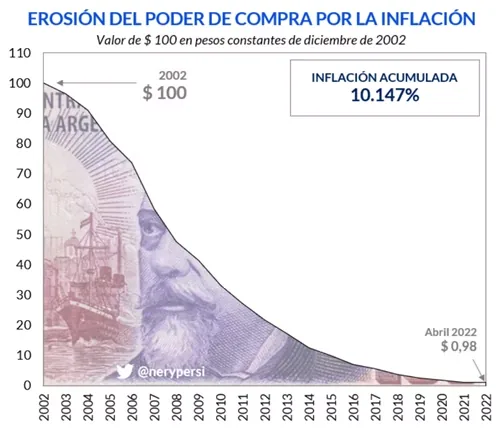
It is then crystal clear that we can conclude the BCRA did not fulfill its main mandate: monetary stability. Let's move on to the next element.
Financial stability:
Of the last 100 years, in 77 of them there was a fiscal deficit. Maybe the fault for this is the Treasury's and not the BCRA's... were it not that the BCRA has constantly served as a financing tool for the political caste. In Argentina monetary issuance is used plainly and simply to cover the current fiscal deficit.
Since revenues are consistently lower than expenses, the Argentine State doesn't have enough money and needs to print bills to cover its spending.
The BCRA issues money and then makes "temporary advances" to the national government to cover the deficit. In accounting terms, the BCRA places "non-transferable bonds" on the asset side, and issues pesos that it places on its liability side. Since Argentina has been abusing monetary issuance for many years and the demand for pesos keeps decreasing, inflation begins to be produced.
What happens here?
So as not to flood the market with pesos with everything it issues, the BCRA tries to "absorb" those pesos through various Treasury financing instruments called bills (debt securities) of short term or Leliqs/Lebacs at the time and pases.
They are instruments designed to absorb pesos from the economy by offering an attractive rate in local currency with the aim of preventing those pesos from going to the dollar. This way, banks buy these Leliqs that offer them a certain rate and then turn around and offer savers fixed-term deposits in pesos at a lower rate, keeping the difference (spread).
If the rate they offer is attractive, then they prevent savers from going to the dollar and therefore pushing its price up. By having banks buy these public securities with pesos, in exchange for a future payment promise, the BCRA manages to absorb those pesos from the economy and "prevents" inflation from spiking in the short term.
It is important to understand that buying Leliqs is basically lending money to the BCRA. With this instrument the BCRA intends for savers to keep rolling it over, and to gradually lower the interest rate. This never works. Let's give a brief example: you lend money to a person. Every time the maturity arrives (time to repay the debt), that person tells you "hey, but are you sure you don't want to roll it over for a few more days?". If you were the one lending the money... what are you going to tell them? OK fine, we roll it over, but you have to pay me a higher rate. If not, I'd rather you give me the money now so I can invest it in something else or consume.
Nobody anywhere in the world rolls you over at a lower rate, unless the numbers and the credit risk (repayment capacity and confidence) of the debtor improve significantly. So if they roll you over, they have to increase the rate and still pay you the interest. If they don't roll you over, they have to print again the money they "absorbed" to pay you, and they also have to pay you the interest they owe you for having lent to them, so in both cases they end up issuing more than they finally absorbed.
This is especially true when you have interest rates of 75%, as in Argentina. Anyone who understands what compound interest does knows you can't pay a 75% interest rate while having a chronic fiscal deficit. The ball of pesos you generate is MASSIVE. Each time you "absorb" more pesos (because the deficit and the monetary base grow) that you then still have to repay and also pay a 75% interest on the loan. This means that from one year to the next, through the reinvestment of interest, you literally DOUBLE the remunerated liabilities, generating a time bomb that sooner or later produces impressive inflation and devaluation.
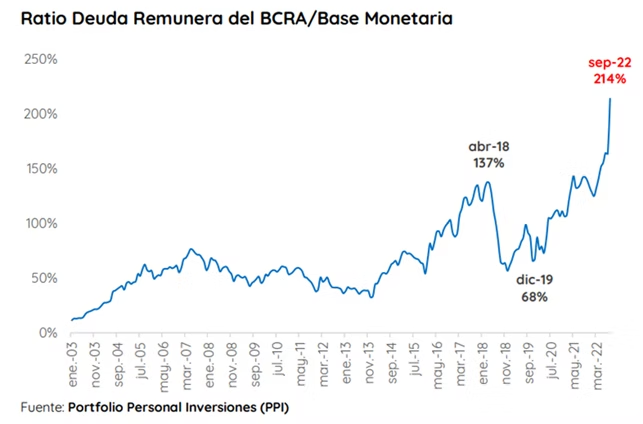
Once you expanded the monetary base by issuing the interest you owe savers, that interest has to find an urgent destination because of the inflation in the economy. There are three possibilities:
- Earn more rate. No one pays you a higher interest rate than the State, so it suits you to keep giving them the pesos if you want to earn a rate.
- Dollarize.
- Consume goods and services.
The first option leads you to return the interest to the BCRA by buying more leliqs to earn a rate, which starts generating the massive ball of pesos we saw is generated when capital and interest are rolled over. The second option generates devaluation. With a greater amount of pesos in the economy and the same (or less) amount of USD, the dollar price inevitably tends to rise. The third option generates inflation. As the monetary base increases, the demand for goods increases (there are more bills going around = people want to consume more) and if this demand is not accompanied by an increase in the supply of goods and economic activity, prices will rise. Since the BCRA and a large part of Argentines think that leliqs can effectively absorb pesos from the economy, the BCRA deliberately chooses to raise the rate so you opt for the first option... thus generating a financial carry trade that sooner or later blows up in a hyperinflation or a mega-devaluation. Let it be clear: remunerated liabilities generate inflation, because the more they raise the rate, the more they have to issue to pay interest. Remunerated liabilities destroy the peso. Raising the rate when the BCRA issues leliqs/lebacs is raising public spending.
Today the ball of pesos the BCRA built is so big that the BCRA's remunerated liabilities are DOUBLE the monetary base in circulation. This is a terrible time bomb that sooner or later finishes exploding, and that was generated exclusively by the Central Bank.
The estimated interest burden for October 2022 alone is $550,000 (five hundred fifty thousand) million pesos, equivalent to 13.2% of the Monetary Base or 0.7% of GDP. That is, just from the interest generated by the BCRA's debt in October, 13.2% of the current monetary base will be issued.
The Leliqs already add up to a stock of 7 trillion pesos, equivalent to a little more than USD 50 billion at the official exchange rate. The BCRA just raised the effective rate of its debt to 100% annual, which implies that if the BCRA keeps these rates it will issue another 7 trillion pesos in a year, just to pay the interest on its debt. And so on...
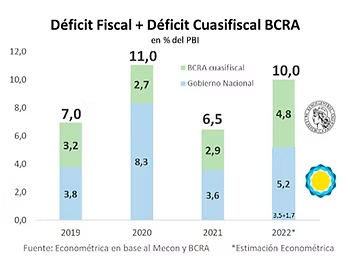
As economist Ramiro Castiñeira of Econométrica explains: "With these rates the BCRA already has a quasi-fiscal deficit higher than the National Government's own deficit. Annualized, 7 trillion pesos of BCRA quasi-fiscal deficit vs 4 trillion of National Government deficit, even with the interest on the public debt. Only in the lead-up to hyperinflation did the BCRA have more deficit than the Treasury itself, as now" (1).
But let's also look at other of the BCRA's "greatest hits":
- The highest interest rates in the world, which generate:
- Total crowding out – The State captures all the financing available in the economy. No private party can pay a 75% interest rate... so the State absorbs the vast majority of the pesos available in the economy. The resources that companies and individuals leave in banks go to finance the State to take advantage of the very high interest rates. The ball of pesos is fed. (2) (3).
- Recession – If the private sector can't finance itself, it can't grow... but in addition these very high rates literally make it more profitable for you to lend money to the BCRA (at a 100% effective annual rate) than to start your own business, so fewer and fewer jobs are created in the private sector. This is how Argentina hasn't grown for more than a decade.
- The highest inflation in Latin America after Venezuela and the fourth highest inflation in the world, for all the reasons we have been saying previously (4).
For all the above, we can conclude that the BCRA has also not been able to fulfill its objective of guaranteeing "financial stability".
If we analyze the last two objectives the BCRA had according to its charter, which are to promote employment and economic development with social equity, you don't have to be a genius to realize that in a country with 50% poverty and very high informal employment levels, the BCRA has also not been able to fulfill its objective on these points.
So:
The BCRA does NOT meet its objectives; it is NOT independent but acts as a "cash register" so politicians can carry out their populist measures to win votes...
But besides it is the main cause why we have:
- The highest interest rate in the world
- The fourth highest inflation in the world
- We suffer because of all this a constant currency devaluation and a terrible recession in the economy...
Why do we want the Central Bank to exist?!
Economist Ramiro Castiñeira continues explaining in his notes: "In this model the BCRA is not the guardian of the currency's value, but the dumb cash register that finances populism. The destruction of the peso is a mirror of the destruction of the BCRA these last two decades. On the asset side it no longer has its own foreign-currency reserves, despite the fact that creative accounting says it has USD 37 billion. On the liability side it has a debt of 7 trillion pesos. With no assets and a liability remunerated at 100%, it has a quasi-fiscal deficit of another 7 trillion pesos. Even if the Treasury didn't ask the BCRA for another peso, the monetary institution would still issue ALMOST TWO MONETARY BASES to pay the interest on its debt, leaving a three-digit inflation floor for 2023."
Other problems the BCRA generates:
As if all the problems we explained earlier weren't enough, the BCRA is constantly looking at how it can keep ruining people's lives. Proof of this are some of the resolutions it has issued in recent years:
- The obligation of exporters to liquidate foreign currency at the official USD – literally an armed robbery.
- Prohibition of buying USD if you sold soy in the Export Increase Program or if you accessed subsidies.
The whole imposed economic model of export taxes and multiple exchange rates is anti-exporter because it decreases the incentives to export and increases the incentives to import!! The opposite of what one would want to happen. The BCRA is responsible for this, having imposed FX controls. (Or do the politicians impose the controls? – In which case the independence of the body is not respected, something that will never happen in this country.)
Proposal:
That in Argentina exporters NOT have the obligation to liquidate their USD. Besides that, zero export taxes. Importers shouldn't access the MULC either; if they want to buy USD let them buy at the MEP USD – or let them buy the USD from exporters.
USD must be traded freely! It is imperative to get the state and the BCRA out of the middle. It is unacceptable that the bureaucrats of the day are establishing which sector can access which dollar, for how long and under what conditions, because that is UNCONSTITUTIONAL – by violating equality before the law and the right to use and dispose of your private property (the USD) as you wish.
What is the main criticism made by those in favor of having a BCRA?
Those in favor of having a BCRA usually say it is important to have this institution so it can intervene (i.e., issue money) in times of crisis.
Let's suppose we agree that the Argentine State must intervene in the economy in times of crisis; the Argentine State will still be able to keep intervening in times of crisis... but only if it bothers to generate reserves in the fat-cow times.
Losing the seigniorage that issuing gives you makes you consistently have to worry about having a fiscal surplus. You have to make sure you always spend less than you generate. By doing that you can create a money reserve, which you can then inject into the economy in times of crisis or recession if needed.
It is necessary to manage the State's economy like an individual's. By having a surplus you build savings, which you can then use in the lean-cow times. If you dollarize the economy the State will be in the same situation as any individual. When you run out of money you can't paint some little papers at home and say that's worth something. This way, you make sure you never run out of money. You worry about generating income, but above all, you are extremely careful with the expenses you have. In the worst case you will have to take on debt, but you know that in the end you will have to generate income higher than your expenses because otherwise you will end up bankrupt.
With the State it's the same! With the possibility of issuing eliminated, taking on debt can only be a last-resort recourse. It is necessary to have a fiscal surplus and generate reserves.
How is that done?
The first step is undoubtedly to fully encourage exports. That is: zero export taxes and a free exchange rate.
Then obviously you will have to forcefully cut public spending. This is the fundamental basis on which any prosperous future we would want to have in Argentina rests. It is necessary to give power back to the individuals who make up society. Align the incentives. Encourage work. For this it is also necessary to reduce the tax burden, the number of taxes and unnecessary paperwork. This must be done in one stroke, without gradualism.
What is clearly not possible is to issue/take on debt constantly every month to finance the deficit, because that generates: inflation, devaluation and very high interest rates = constant crisis. It ends up happening that the State, with its debacle, drags down the rest of the country's economy.
It is almost impossible for the Argentine peso to have a better performance than the dollar in the future. If you stay tied to the dollar at least you know the currency you use will be among the top performers. The United States may print and charge seigniorage to all who use the dollar, but they know they also can't overdo it because: a) they lose confidence as a store of value and; b) inflation rises.
Today as things stand it suits Argentina to stay tied to the dollar. Argentine politicians have shown they don't know how to control their spending and for that they constantly run the little machine. It is necessary to eliminate the little machine so it never comes back.
Those who keep defending the BCRA, ask yourselves... Since you were born, what joys has having a Central Bank given you? If the answer is none, why do you keep defending it? They are all bad. To keep defending the BCRA is the equivalent of having Monetary Stockholm Syndrome. Even though the BCRA has been complicating your life since the day you were born, since you can't imagine an economy without the BCRA you refuse to shut it down. It is the equivalent of the kidnapped person who can't imagine their life without their kidnapper. In life you have to learn to let go...
OK let's suppose you followed me this far:
How can an orderly process of closing the BCRA happen?
The BCRA has a quasi-fiscal deficit of between 4.8 and 5% of GDP. The FIRST thing that must be done is to try not to expand the monetary base by a single peso more. That is the first measure you have to take to fight inflation.
This wouldn't imply dollarizing de facto; the peso can keep existing... only that not a single peso more can be issued. This way the transition to dollarization is less violent and doesn't force you to validate any exchange rate because the peso will keep being accepted in the economy.
Then, the BCRA has to transfer its debt to the Treasury, which would take charge of paying the interest generated by the BCRA's debt. For this, obviously the Treasury has to make a massive cut in public spending, so it generates enough savings to pay the Central's debt. It is necessary to return to public-spending/GDP levels of 2004, when it was at 23/24%. If there was room to raise it, there is also room to lower it.
Once all the BCRA's debt has been paid (it may take a few years) then it will be time to close it forever. Let's remember that the counterpart of the leliqs is the fixed-term deposits, so not paying them would unleash a financial crisis of magnitude in the country.
Until the BCRA is completely closed, the peso can keep existing and competing against the USD. The watchword is simply not to issue a single peso more; if you comply with that the peso could keep existing and compete freely with the other currencies. The idea would be to gradually tend toward a fully dollarized economy, which would allow the lower and middle class to start saving, and also bring back to the country a large part of the Argentine savings that populism expelled.
Economist Nicolás Cachanosky explains: "The inability to have a stable currency implies the inability to have an economy that, in the long run, develops, instead of going from crisis to crisis. If the monetary problem is not solved, there is no economic plan or super minister that can bring order to the country's economy." (5)
Concrete ideas to cut public spending: Where there's a will, there's a way.
- Privatize state companies – There are 33 companies belonging to the National State and most of them are not profitable. These companies have an operating deficit representing 0.7% of GDP. That is financed by the Treasury – that is, all of us through legislated or inflationary tax. With the numbers emerging in 2022, the operating deficit would already be exceeding 4.2 billion dollars (6).
Just by making these companies profitable (assuming you keep some) or selling them, we save 0.7% of GDP... but in addition if we sell some of these companies the Treasury can build up cash to pay its own and the BCRA's interest.
The nature of the deficit of public companies is not the same for all. There are nuances. Some are practically forced to have a deficit because they charge for their service much less than the cost of that service. It is necessary to increase the value of these services – but this must be offset by a significant cut in the taxes charged (like a total elimination of export taxes – and many other absurd taxes that exist). The tax burden in Argentina must be drastically reduced to offset this effect.
For those who say that reducing the tax burden in Argentina will lead to a greater deficit, I recommend familiarizing yourselves with the Laffer Curve – which establishes that a decrease in the tax burden can in fact help increase taxes if we came from a tax burden so high that it generated more incentives to evade (informal economy) and fewer jobs.
https://es.wikipedia.org/wiki/Curva_de_Laffer
- Eliminate political-caste expenses – maximum two advisors per legislator. There are legislators with more than 44 employees (7). An absolutely unnecessary cost in a country with 50% poor. In addition, eliminate state bodies that produce nothing and are a source of unnecessary expenses, like the Ministry of Women, the Ministry of Culture, the INADI, the INJUVE and several others.
Also drastically reduce the salaries of 23 thousand USD that Argentine ambassadors collect for vacationing abroad (8). Although this measure won't have much impact in terms of GDP savings, it is necessary for the political caste to set an example for its citizens or be removed from their posts forever.
Finally, eliminate all kinds of state advertising to the media and the obligation the State has to finance political campaigns when there are elections. It is immoral for politicians to spend funds campaigning in a country where half the population is poor. Besides it is unbearable to see their billboards and hear them on the radio, all funded with our taxes.
From January to August 2022 alone, the province of Buenos Aires spent 8.5 billion pesos on state advertising (9). In addition, between December 2020 and August 2021, the national government spent 7,563 million pesos on official advertising (10), so this year adjusted for inflation must be much more. But then they tell you public spending can't be cut. The reality is the political caste uses public spending to consolidate itself in power and do as it pleases.
- Audit of social plans – That they can't be in eternum. With limited terms and with a counter-service required (building roads or anything else that's needed).
- Reduction of public employees – for that it is necessary to make labor laws more flexible and adjust the macro so those people can then find a job in the private sector.
- Transfer expenses and tax powers to the Provinces. Elimination of federal revenue sharing (coparticipación).
The revenue-sharing law establishes that the provinces delegate to the National Executive Power the application and collection of all national taxes. The agreement is that the Nation collects, and then distributes what is collected to each Province. This means provinces have no incentive whatsoever to produce. They know they will be maintained by the Nation anyway, and that anything they collect won't stay for them.
So what do they do?
They don't collect and don't produce. They don't incentivize production because they can't keep any piece other than the one determined by the revenue-sharing law. So no matter how much one province produces more than another, they all receive the percentage determined by the law or the government of the day.
If you already know that, whether you make an effort or not, you will receive the same, then you have no incentive to make an effort. That is what happens in the Provinces, which is why the vast majority run deficits.
In the United States, a federal country par excellence, each state collects its money, and then contributes to the National Government, the opposite of what happens in Argentina where the National State collects and then distributes via revenue-sharing to the provinces. It matters who collects the money, because that institution is the one that has the power or not to send it afterward. The Executive Power in Argentina often deliberately delays sending the money owed to a province via revenue-sharing, when the governor of the day is not to the liking of the National Executive Power.
Revenue-sharing dynamites not only fiscal federalism, but also eliminates tax competition between provinces. In the United States, if a state wants to attract investment, it can lower taxes and companies can move without leaving the country to benefit from that measure. In Argentina this can't be done, because the tax burden is the same throughout the country since the vast majority of taxes are national. So if you don't like the rules of the game the National State imposes, you directly have to go to another country. Companies have no possibility of moving between provinces because they all have practically the same tax burden. Conclusions:
By cutting public spending considerably it is possible for the BCRA to transfer its debt to the Treasury, which would take charge of the maturities. This way, by eliminating the BCRA we would lower inflation, devaluation, interest rates and the consolidated deficit (through the gradual elimination of the quasi-fiscal deficit) in one stroke. This would reactivate the economy, generating new jobs, greater confidence for investors and clear rules of the game.
Obviously if we don't cut public spending none of this is possible and Argentina will continue forever in the economic and social decline it has been immersed in for years.
For those who think cutting public spending is recessive, I leave you at the end a note by economist Roberto Cachanosky where he explains that: Since the State produces nothing, everything the State spends is money that individuals stop spending instead, since the State charges it to us in the form of taxes, inflation or debt (future taxes). This has the aggravating factor that what the bureaucrat of the day wants is produced and not what people need, so there is a terrible allocation of resources that doesn't generate wealth (11).
Back to the topic of closing the BCRA and dollarizing, as Alfredo Romano explains, Director of Romano Group and of the Capital Markets diploma at Universidad Austral. Master in Finance and Public Policy (Columbia University):
"Any Argentine knows what it is to suffer the scourge of inflation. We are the most inflationary economy on the planet of the last 40 years, and currently, we have the fourth highest inflation on the planet. Since the creation of the BCRA in 1935, we have had only 17 years of single-digit inflation, while the other 70 years it has been double-digit. By not having a BCRA independent of the interests of the government of the day, that institution has become a blank check for the rulers, being the main responsible for the uncontrolled monetary issuance and the inflation tax. So it turns out the Central Bank is the platform of the macroeconomic imbalances in our country." (12)
Despite that there are many economists who think that "if Argentina did its homework on structural reforms in different key areas of the economy" it wouldn't be necessary to close the Central Bank. But if Argentina did what needs to be done, we wouldn't have all the structural and macroeconomic problems we live with daily.
Let's suppose Argentina did the necessary reforms today. How do we know that in the future a new populist government won't come to run the little machine again? That is why dollarizing is the safest option, because it is the only reform that has the capacity to stay over time.
Politics has no incentive to lose its most precious and easily accessible cash register: monetary issuance. It is up to us to eliminate it so they can never use that tool again. Let it be clear: eliminating the little machine is taking power away from the political caste, so it is logical that all politicians are against this measure.
Dollarization emerges as the best option because it is capable of putting monetary policy in order, generating an enormous confidence shock toward society and radically limiting the possibility of using the Central Bank as an unlimited financing cash register. This monetary reform also has the capacity to stay over time, preventing the possibility that a new populist government comes and starts issuing. You take away from politicians the bill-counterfeiting machine.
The Argentine State will be able to keep intervening in the economy in times of crisis, if and only if, it bothered to generate savings and reserves in times of abundance. Otherwise, it is not appropriate for it to intervene with monetary issuance because that generates inflation and devaluation, which ends up hurting the poor more and is also morally wrong because it is a non-legislated tax. It is not right for the government to spend more than it collects and then send the bill to the population through the inflation tax.
For those who think closing the BCRA is crazy... Einstein said that "insanity is doing the same thing over and over expecting different results".
That's all, folks, I hope it wasn't too boring :)
Until next time!
Sources:
(1) https://www.infobae.com/opinion/2022/08/21/el-banco-central-argentino-esta-quebrado/ (2) https://www.infobae.com/economia/2022/10/05/con-tasas-de-interes-superiores-al-100-anual-se-derrumba-el- credito-al-sector-privado/ (3) https://www.infobae.com/economia/2022/08/12/la-tasa-de-interes-en-la-argentina-es-la-mas-alta-del-mundo- como-compara-con-las-de-otros-paises/ (4) https://www.infobae.com/economia/2022/07/14/detras-de-libano-sudan-y-venezuela-argentina-se-consolido- entre-los-paises-del-mundo-que-tiene-la-inflacion-mas-alta/ (5) https://www.lanacion.com.ar/ideas/dolarizacion-un-debate-caliente-ante-un-peso-que-no-deja-de-perder-valor- nid08102022/ (6) https://www.clarin.com/especiales/empresario-90-000-empleados-perdidas-4-000-millones- dolares_0_wPYJTzg0N5.html (7) https://www.infobae.com/politica/2022/05/16/quienes-son-los-senadores-nacionales-con-mas-de-30-empleados/ (8) https://tn.com.ar/politica/2022/09/25/con-sueldos-de-hasta-us-23-mil-los-embajadores-argentinos-cobran-el- doble-que-sus-pares-de-paises-vecinos/ (9) https://www.infobae.com/politica/2022/10/09/como-distribuye-axel-kicillof-los-fondos-destinados-a-la-publicidad- de-su-gestion-como-gobernador/ (10) https://www.lanacion.com.ar/politica/pauta-oficial-el-gobierno-gasto-7563-millones-en-un-reparto-que-tuvo- premios-y-castigos-nid07102021/ (11) https://www.infobae.com/opinion/2022/03/08/el-mito-de-que-bajar-el-gasto-publico-es- recesivo/#:~:text=Considerando%20que%20solo%20en%20el,el%20gasto%20p%C3%BAblico%20sea%20recesivo. (12) https://www.infobae.com/opinion/2022/07/30/dolarizar-para-empoderar-a-la-sociedad/

Financial Advisor · Author · Columnist