
Macroeconomics · International
The FED: The most important player in the markets.
Contents
Miguel Braun · Feb 9 2022 · 10 min read
Dear readers, a pleasure to welcome you to this space again. In this chapter we'll analyze: what the FED is, what role it plays in the markets, when to buy stocks, and what's happening now. This is the most important thing you need to know when investing and for finance in general: monetary policy. Let's start.
What is the FED?
The FED is the institution that determines United States monetary policy. Basically, they regulate interest rates and the USD supply in the economy, aiming to achieve full employment and price stability.
In recent years, the FED has played a predominant role in world markets determining US monetary policy. The dollar is a currency historically considered a safe haven and store of value worldwide, and is also used as an exchange medium. The world's safest asset is considered the US Treasury bond, and many assets are denominated in USD (stocks, bonds, commodities, cryptos, real estate, art). This makes it a currency with enormous global demand.
Taking advantage of this, the FED often uses monetary emission as a way to stimulate the US economy, to achieve GDP growth. However, since the 2008 crisis, the FED has been injecting (printing) a very significant amount of dollars into the markets, which caused an impressive rise in the stock market and gradually started to heat up US inflation. In the last crisis generated by the coronavirus, they printed so much money that inflation finally shot up to 7.5% annually.
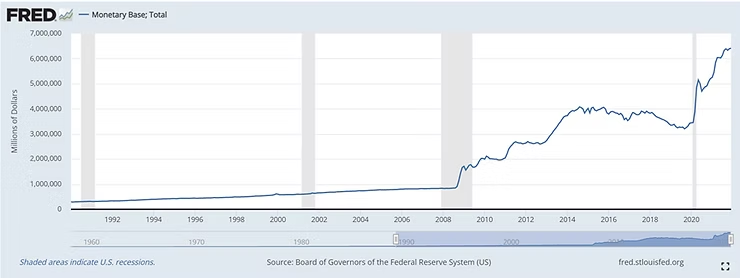
Since the last financial crisis in 2008, the FED literally multiplied the US monetary base by 6. This implied injecting trillions of USD in the markets. But since the dollar is a "savings unit" currency, the Federal Reserve's emission doesn't end up impacting traditional assets like food or consumer goods as much. On the contrary, the emission is channeled into financial asset purchases generating an almost permanent rise usually called "reflation".
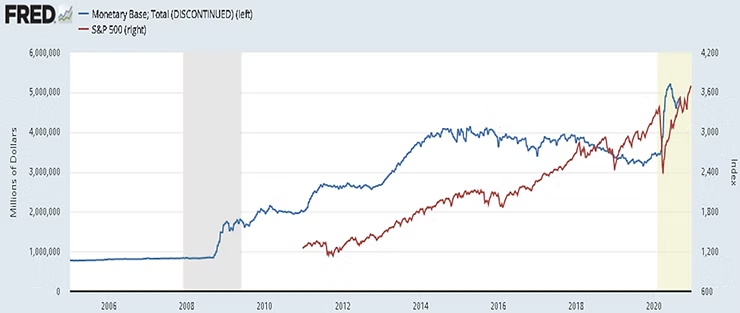
Monetary emission thus feeds the price of stocks, bonds, commodities, real estate, cryptocurrencies and some other assets. In recent years, monetary emission has been the main driver moving markets. Every time the FED and other Central Banks around the world turn on the printer, all that excess money they inject translates into price increases in listed assets, as well as real estate, art, soccer players and other assets.
As we can see in the chart below, every time the monetary base expanded, the market followed by rising. In 2016, when the FED began to reduce the monetary base (tightening), the remedy Trump came up with was a tax reform that lowered taxes, to keep the market on its bullish trajectory.
How do the FED and the European Central Bank inject USD?
Emission in the United States and Europe occurs via purchase of financial assets in the market, mainly bonds of the US Treasury or the European Central Bank itself, mortgage credits and even sometimes corporate bonds of companies. By buying Treasury and corporate bonds, the FED: first, raises demand for these bonds thus preventing big price drops and lowering interest rates. Second, raises cash level and liquidity across all markets.
"Quantitative easing" or QE is a process sometimes colloquially described as "printing money", since asset purchases in the market by the FED are done with new money created by it. Money emission occurs through financial assets, and not by financing the government with temporary advances never returned, as in Argentina.
When should you buy stocks?
The best time to buy stocks is when the FED and other world Central Banks are emitting, because you know the quantity of money is rising and therefore asset prices will keep rising. Paradoxically, the best time to invest is then in the middle of a crisis, or just after (as happened with the coronavirus crisis). This way you can buy assets at discount prices, and you also know the FED and other Central Banks will probably turn on the printer.
This tailwind also greatly helps Argentina and other emerging countries because commodity prices they export also rise a lot, and because ultra-low global interest rates generate that investors are willing to invest in riskier assets (like emerging-market assets).
What is happening now?
Now you're late, my friend. US inflation shot up to 7.5% annual and the FED announced it's ending its financial asset buyback program in March and will start raising interest rates throughout 2022. Also, they announced they're already considering starting the balance sheet reduction process. This implies a reduction in monetary base, which could lead to price drops… considering they've been inflated by many years of expansionary monetary policy.
As long as the dollar continues being demanded as a global savings reserve, the FED can continue this monetary policy to exit crises. The problem is once you emit all this money, it's very hard to remove it without generating abrupt market drops. Experts call this "the liquidity trap".
Final recommendation:
In my opinion, it's impossible that they can withdraw all the liquidity injected. That would unleash a market drop of such magnitude that it would be recessive for the global economy. The FED knows this perfectly and won't reach that extreme… but it's possible to see a reduction in US monetary base over the next two years.
This implies being very careful about the assets one buys. The tailwind is over and those who will suffer most are speculative assets. Focus on value companies, with good fundamentals and stable long-term growth. Eventually they'll emit again, and there we should be attentive to know specifically which assets to buy.
That's all! I hope you liked it. If you made it here and liked the report, leave me your comment on the page! :)

Financial Advisor · Author · Columnist