
Global · Automotive
STLA (Stellantis): A good investment opportunity
Contents
Miguel Braun · Jul 20, 2022 · 5 min read
On January 16, 2021, Peugeot S.A. ("PSA") merged with Fiat Chrysler Automobiles N.V. ("FCA N.V."), with FCA N.V. being the surviving company of the merger. On January 17, 2021, the combined company was renamed Stellantis N.V.
Stellantis N.V. is an international automotive group headquartered in the Netherlands. The group operates and markets the car brands Fiat, Alfa Romeo, Lancia, Maserati and Abarth of FCA Italy; Jeep, Chrysler, Dodge and RAM of FCA US; and Peugeot, Citroën, DS, Opel and Vauxhall of Groupe PSA.
The subsidiaries of both FCA and PSA also became part of Stellantis' portfolio. This also includes manufacturers of other types of vehicles and suppliers of technologies and auto parts.
Positive actions:
In 2021, Stellantis announced its intention to make all vehicles of its brands electric by 2025. In addition, it has been focusing on autonomous driving technology and on reducing the vehicle's total energy demand, fuel consumption and emissions.
Expected merger synergies:
As a result of the merger, they expect to achieve significant synergies from the integration of all the businesses, particularly in the following four areas:
- Technology, Platforms and Products. Sharing platforms, modules and systems, along with the optimization of investments in research and development, is expected to generate significant efficiencies.
- Purchasing: Procurement savings are expected to result from leveraging the company's expanded scale, leading to lower production costs, better prices and broader access to new suppliers.
- Selling, general and administrative expenses ("SG&A"): Savings are expected from the integration of functions such as sales and marketing, and cost optimization in regions where the business has a well-established presence.
- All other functions. Synergies are expected in the optimization of other functions, such as logistics, where savings are expected in the optimization of logistics for new cars, as well as in the supply chain, quality and after-sales.
In the year ended December 31, 2021, the company managed to save approximately 3.2 billion euros thanks to synergies.
Risks:
As is typical in the automotive industry, Stellantis' vehicle sales are very sensitive to general economic conditions, the availability of financing in the economy and consequently the levels at which current interest rates for dealers and retail customers stand. The operation is also influenced by other external factors, such as fuel prices. As a result, sales and results can vary substantially from quarter to quarter and year to year.
Retail consumers tend to delay buying a new vehicle when disposable income and consumer confidence fall. In addition, increases in inflation can lead to subsequent increases in the cost of loans and the availability of credit for vehicle financing, which can influence retail consumers to delay buying a new vehicle.
No member of senior management beneficially owns 1% or more of the Company's ordinary shares.
Why is it a very good opportunity?
Because the company is extremely cheap, but it also generates very good returns on capital employed and has a positive track record of having generated profits in recent years.
The company is literally trading at a value below the cash it has available according to the latest annual balance sheet presented as of 12/31/21 (market cap < cash). In addition, it also trades below the value of its net worth, which remember is assets minus liabilities.
For the 2020 and 2019 results we evaluated only the results of PSA Peugeot, which for accounting purposes was understood to be the acquiring company, so the merger was treated as a "reverse acquisition" (remember the surviving company was FCA).
Property, plant and equipment:
As of December 31, 2021, Stellantis' facilities (including vehicle assembly plants) were located mainly in Europe (France, Germany, Italy, Spain and the United Kingdom), North America (U.S., Canada and Mexico) and South America (Brazil and Argentina). Stellantis companies have historically also owned other important properties, including parts distribution centers, research laboratories, test tracks, warehouses and office buildings. The total book value of Stellantis' property, plant and equipment as of December 31, 2021 was 35.5 billion euros. Therefore, we can observe that the company trades slightly above its PPE... which is calculated based on what it would cost to replace these assets it has now with new ones.
Normalized earnings:
Stellantis experienced a loss of approximately 20 percent of its planned production for 2021 as a result of chip and semiconductor orders that could not be delivered. Stellantis also experienced a significant increase in the cost of raw materials that has been partially mitigated by the merger synergies.
Even so, considering the 2021 results, which can be labeled a low or normal year, the return on capital employed, the return on equity and the earnings yield considering the current stock price are spectacular.
DCF:
If we take last year's free cash flow (2021) and apply growth of only 2% in perpetuity over the next 20 years, and use a 10% discount rate, we get that the company's intrinsic value is $110,947.17, which gives us 175% upside over the current value.
If we apply no growth and use the same discount rate, the result we get is $96,986, which gives us 140% upside over the current value.
Value relative to similar companies:
As we can see, STLA is the only one of the comparable companies in the industry that trades below the cash it has. In addition, it is also the one with the lowest amount of net financial debt relative to the company's net worth. Finally, it is by far the one that generates the highest return on capital employed, the one with the best earnings yield and the one that trades cheapest in price/free cash flow terms.
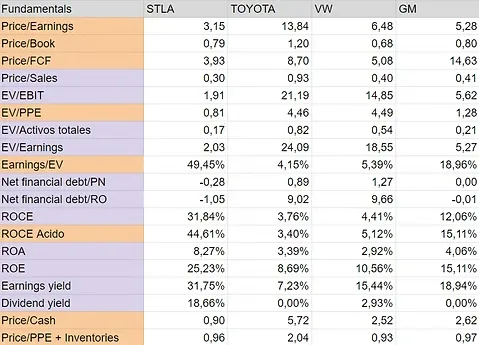
It is worth clarifying that the STLA numbers vs the comparables were added on 08/04/22 and that is why they vary from the STLA numbers placed above... due to the difference in dates and the price at which each analysis was done. The previous fundamentals were taking into account the price on the publication date of the note, which was 07/20/2022. It doesn't change the analysis at all, just that the stock had already been rising in price since I published the note.
Conclusions:
You rarely see a company that trades below the cash it has and below the value of its net worth... but that also generates the spectacular returns STLA was generating in 2021. The company is cheap relative to what it generates even if we only take what the PSA Peugeot brand generated... if we combine all the other brands the results are much better still and the company is even cheaper. The company is being punished by the current context of rising interest rates, inflation and recession being experienced worldwide... but this is the moment to buy. If we are going to wait for everything to be fine in the economy to buy it, then the price we will pay for the company will be much higher.
"Be fearful when others are greedy, and greedy when others are fearful."
Recommendation: STRONG BUY.

Financial Advisor · Author · Columnist