
Brazil · Mining
VALE: The goose that lays the golden eggs
Contents
Miguel Braun · Jun 29 2022
What is Vale?
Vale is one of the largest miners in the world by market cap. They extract and refine metals and minerals directly and via joint ventures in various countries around the world: Brazil, Canada, USA, Chile, Argentina, Peru, Paraguay, Australia, Indonesia, New Caledonia, Malaysia, Mozambique, Oman, India, England, Japan, South Korea, China and Taiwan. They also have a wide logistics and distribution network including railroads, sea terminals, ports and warehouses.
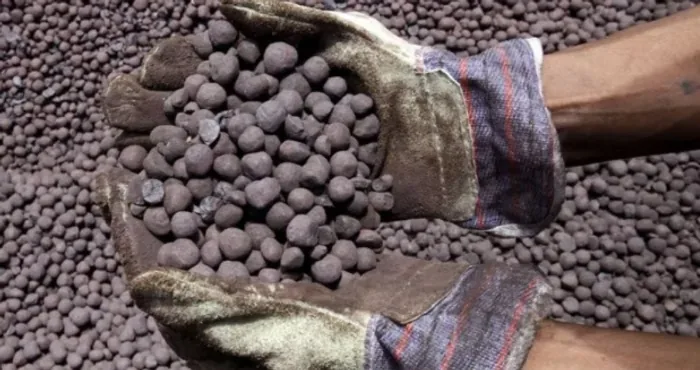
What they produce most is iron ore, the main element used to make steel worldwide. Iron ore and iron ore pellet sales account for 84% of Vale's total sales. They also produce nickel (10%), copper (4.8%) and other products.
In 2021, China was the buyer of 64% of the total iron ore produced by Vale, so Chinese economic growth is also a major factor. 2021 iron ore exports: Asia – 79%, Europe – 7%, Brazil – 10%, Middle East – 3%, Others – 1%.
Competitors: BHP Billiton, Rio Tinto, Arcelor Mittal, Gerdau S.A., among others.
In addition to all mining, Vale has other businesses: Logistics, Energy and steel production.
Logistics: Vale developed its logistics business based on the needs it had to transport the output of its mining operations, and today offers transport services to other clients too. Its logistics network includes sea ports, railroads and cargo ships worldwide. In Brazil alone they operate 2,000 km of rail lines.
Energy: 54% of the energy Vale consumes to carry out its business is self-generated, and comes mainly from hydroelectric and wind energy production. In Brazil, Vale's energy consumption equals 2% of the total energy consumed in the entire country.
Steel production: They work on steel production via joint-ventures, like the one they have with ThyssenKrupp Companhia Siderúrgica do Atlântico (TKCSA) in Rio de Janeiro. It's one of the largest and most modern steel mills in the world.
Risks:
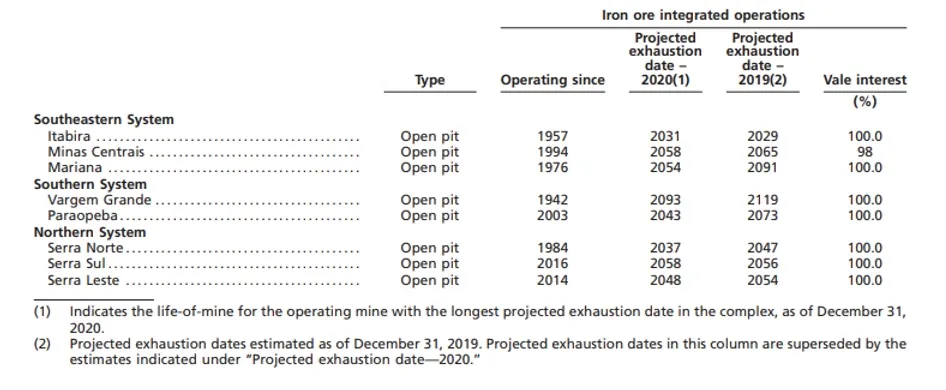
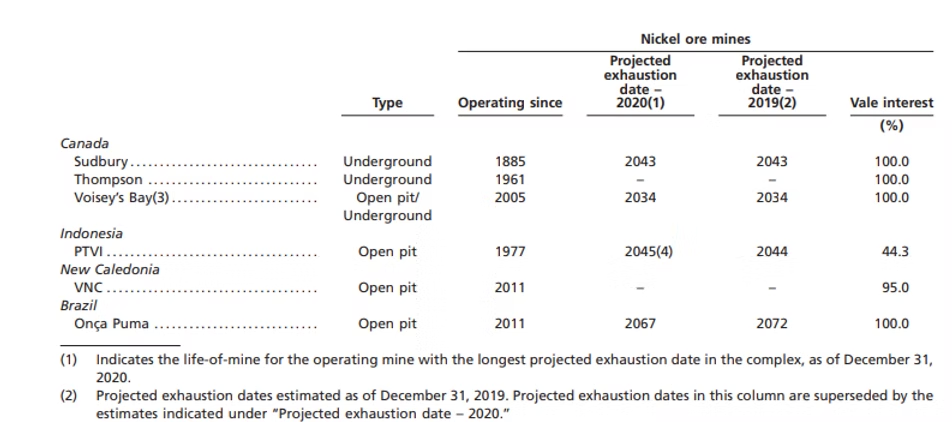
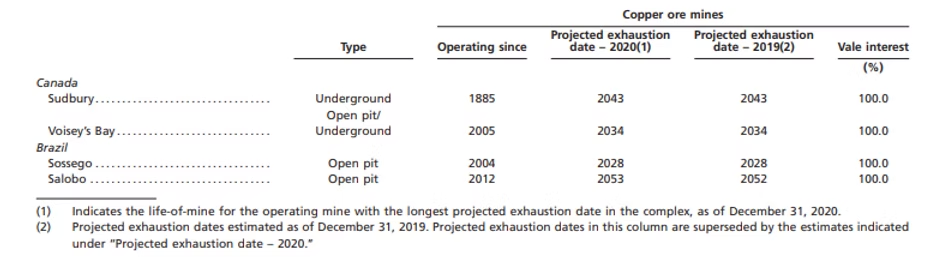
One of the main risks of buying a mining company is precisely that its mines run out of product. In the tables below we can see since when they operate the mines they have, and the estimated date by which they would extract all available product from them. As we see, they still have several years in almost all their production sites.
Iron Ore
Nickel
Copper
Other risks: On January 24, 2019, a dam Vale operated broke in the city of Brumadinho, state of Minas Gerais. The rupture resulted in 270 deaths. The company is taking precautions so events like that don't happen again and has been paying the due compensations.
"We will never forget Brumadinho. We reaffirm our respect for the victims and their families, prioritizing the fair and agile reparation of Brumadinho. As we progress on our path to do our business better, valuing people, safety and reparation, we remain firm in our commitment to become one of the safest and most reliable mining companies in the world".
At that time (01/24/19) the stock went from $14.80 to $11.20 (-24%) overnight. Then in the worst COVID crisis (March 2020) the stock went to $6.60 (-55% from pre-Brumadinho price).
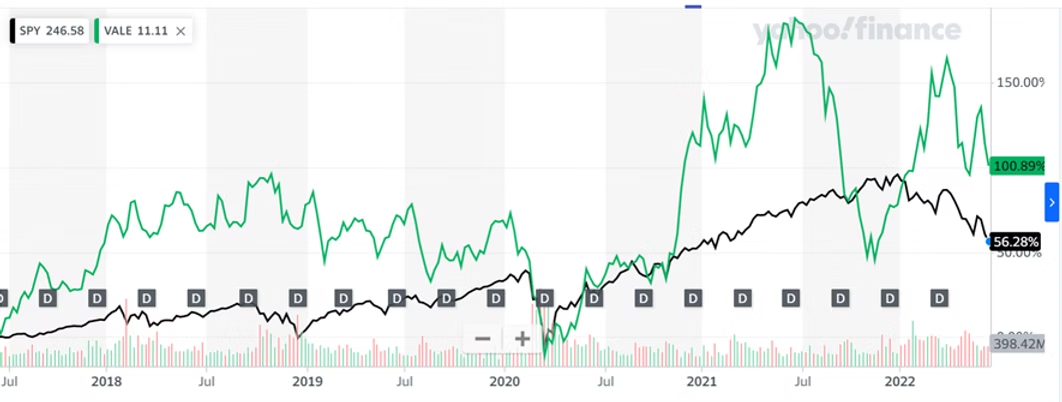
BUT… even having bought the stock the day before the Brumadinho catastrophe, if you'd held until June 2022 you'd now be up 10%. Also, you'd have collected $3.56 per share in dividends meanwhile. While VALE rose 100% in the last 5 years, SPY "only" rose 56%:
Some data:
In 2021 the average iron ore price closed at US$159.49/dmt, 46% higher than in 2020. The move toward a more efficient steel industry, compliance with stricter environmental policies in China and Europe's decarbonization should increase demand for high-quality iron ore.
Aligned incentives: All VALE employees receive compensation based on company performance, aligning employee incentives with those of the company.
Debt cancellation: VALE is a company with very little debt. At end of 2021 they had 12.18 billion in financial debt but 11.721 billion in cash — net debt equivalent to 2% of net earnings. On June 3, 2022 the company offered to cancel a large part of its debt via a tender offer, being successful and canceling 100% of the maximum amount set (20% of total debt).
Share buybacks: In 2021 they bought back 5.48% of outstanding shares for USD 5.5 billion. They keep another buyback program active for 500 million shares (10% of current capital). This practice puts a floor on the price and grows the percentage of the company each shareholder owns.
Dividends: VALE has a dividend policy that requires the company to distribute 30% of EBITDA in two semi-annual installments. In 2021 they paid $2.76 per share dividend, giving an 18% dividend yield on the current price.
On to the numbers:
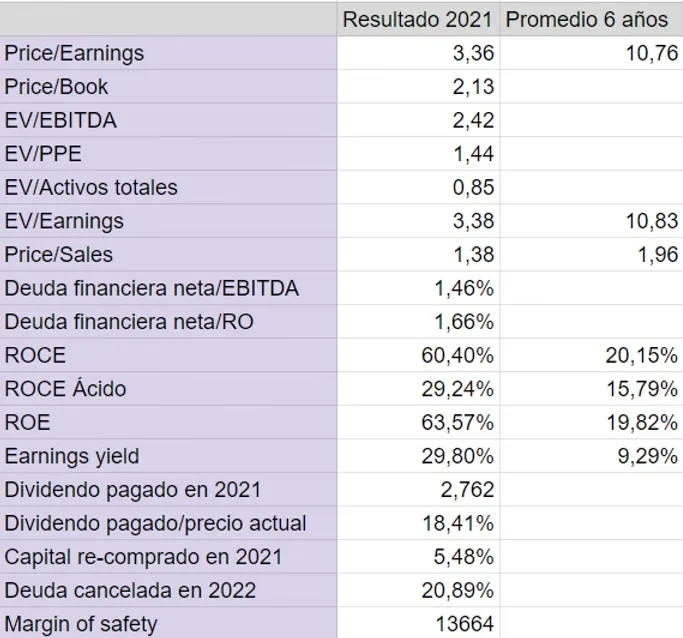
At what price are we buying VALE per 2021 annual results and at what price are we buying vs. the average results of the last 6 years?
Key takeaways:
- The fact that ratios are better in 2021 than the 6-year average tells us the company has been growing strongly in sales, operating income and net earnings.
- The company's Enterprise Value is less than the book value of its assets. That is, you can buy the whole company for less than its assets are worth. This means if you sell all the assets you have enough to buy all shares, pay all debt, and you have USD 13.664 billion left over.
- At the price you're paying now, the company earns 29 USD for every 100 it invests. Excellent return on capital employed.
- How does it return capital to shareholders? They've been buying back shares, canceling debt and paying dividends. All this plus reinvesting in the business's own projects, spending USD 5 billion a year on capex.
Bottom line:
Mega strong BUY. Very good long-term investment opportunity. Also, VALE has cedear so you can buy it in crisp pesos and it hedges you against USD rises.
06/29/2022 - Current price: 15 USD per ADR.
"Price is what you pay, value is what you get."

Financial Advisor · Author · Columnist